
Home > News

ServiceNow and Kafka: Integration Platform (3/3)

Synchronizing data between ServiceNow and Kafka through a middleware platform

Placeholder hero image
Konstantin Tiz
Konstantin Tiz
Founder & CEO

1 July 2026


Considering an integration platform?

Let’s talk
Integration

Synchronizing via a Platform

Part three closes the series: a middleware platform sits between ServiceNow and Kafka, transforms data in transit, and handles many sources at once - at a price.

Three Ways to Connect ServiceNow and Kafka

In 2023, the Rynex team worked closely with one of our clients to validate different ways to connect ServiceNow and Kafka. We want to share that experience with the community, in the hope that it helps you in your own project and saves you time on research.

As part of our research, we examined three possible ways (proofs of concept) to connect ServiceNow to Kafka:

This final part looks at a route that sits between ServiceNow and Kafka rather than inside either of them.
What an Integration Platform Is

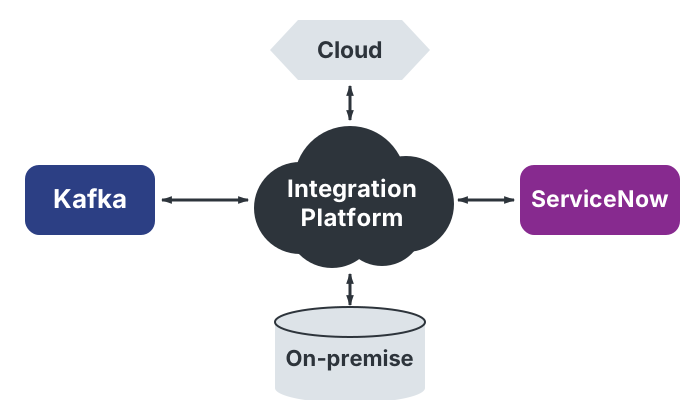
An integration platform is a comprehensive software solution designed to connect disparate systems, applications, and data sources within an organization. It enables a seamless flow of data across platforms, supporting efficient communication and data synchronization.

Integration platforms typically provide a central interface where users design, manage, and monitor their integration processes. They offer a wide range of capabilities (data mapping, transformation, error handling) to ensure data consistency and reliability.

Diagram: an integration platform as a hub connecting Kafka, ServiceNow, cloud and on-premise systems

Pros of an Integration Platform

  • Streamlined data exchange: Smooth data exchange between systems removes the need for manual data entry and reduces the risk of human error.
  • Efficiency and productivity: Automation cuts the time and effort needed to manage data across multiple applications.
  • Scalability: Platforms are built to handle large data volumes and scale as an organization grows.
  • Flexibility: They support various integration methods, such as APIs, webhooks, and connectors, so you can integrate with a wide range of applications and systems.
  • Near-real-time data sync: Many platforms keep data up to date across all connected systems in near real time.
  • Error handling: Built-in mechanisms identify and address issues during integration, protecting data integrity.

Cons of an Integration Platform

  • Cost: Integration platforms can be expensive. Costs may include licensing fees, maintenance, and training.
  • Complexity: Implementing and configuring a platform can be complex and may require skilled personnel or specialized expertise.
  • Data security risks: Improper configuration or insufficient security measures can introduce vulnerabilities and potentially lead to data breaches.
  • Dependency: The organization becomes dependent on the platform; any downtime or issue can disrupt data flows and business processes.

GDPR Aspects

The General Data Protection Regulation (GDPR) is a crucial consideration when using an integration platform. Because the GDPR governs data protection and privacy for EU citizens, organizations must ensure that data transferred and processed through the platform complies with its requirements.

  • Data protection and consent: Obtain explicit consent from data subjects before transferring their personal data through the platform. The platform should support consent management and safeguard data privacy.
  • Data minimization: Collect and process only the data necessary for a specific purpose. The platform should let you control the data flow and limit sharing to what is strictly required.
  • Data security and encryption: The platform should employ robust security measures, such as encryption, to protect data in transit and at rest.
  • Data retention and deletion: Keep personal data only as long as necessary and delete it on request. The platform should support retention policies and enable timely deletion.
  • Data subject rights: The platform should let you respond promptly to data subject requests, such as access, rectification, and erasure.

By addressing these GDPR aspects during implementation and use, organizations can ensure compliance with data protection regulations and maintain the trust of their customers and partners.

Key Components

  • Integration platform: Acts as a mediator between ServiceNow and Kafka, ensuring seamless data exchange and synchronization.
  • Transformation logic: Data retrieved from ServiceNow is transformed to fit the required schema of the Kafka topics, ensuring compatibility and consistency.
  • Error handling mechanism: A robust mechanism addresses any failures that occur during synchronization.
  • Data consistency measures: The platform enforces data consistency between ServiceNow and Kafka to avoid discrepancies.

Implementation Steps

Several integration platforms can connect ServiceNow and Kafka to enable data synchronization and communication between the two systems. Commonly used platforms that support this integration include Tray Platform, MuleSoft Anypoint Platform, Zapier, Informatica Intelligent Cloud Services, and Boomi (Dell Boomi). For this article, we used the Tray Platform to connect ServiceNow and Kafka and to test the feasibility of the implementation.

Setting Up the Environment

  • Deploy the ServiceNow instance with a configured user that has the required permissions for the defined tables.
  • Configure and deploy the Kafka cluster along with the required user groups, users, and topics.
  • Implement the workflow for the use case.

Testing and Validation

  • Perform extensive testing to ensure the accuracy and consistency of data synchronization.
  • Validate data integrity and verify that errors are handled appropriately.

Performance and Monitoring

  • Measure the performance of the synchronization process, including data throughput and latency, and identify potential bottlenecks and areas for optimization.
  • Document the entire implementation, including configurations, code, and integration details.
  • Prepare comprehensive monitoring.

Conclusion

Configuration, implementation, and final cost can vary greatly depending on the platform and the use case; that said, most integration platforms provide the same set of functions and capabilities.

This connection method lets you use multiple data sources and manipulate data during transfer, but the implementation can require significant effort.

Let’s work together

Our team would love to hear from you.

ServiceNow Partner Badge ISO 27001 zertifiziert